
Chambers County Criminal Court Records
A criminal court record in Chambers County is the case file kept by the Circuit Clerk once a criminal case is opened in court. It is not just a list of arrests. The file can include the complaint, warrant, indictment or information, plea, bond, docket entries, motions, orders, hearing dates, disposition, sentencing order, fines, costs, probation terms, restitution, and appeal entries. The Circuit Clerk is the official record keeper and business manager for Circuit and District Court proceedings, so Circuit and District criminal records route through that office or through Alabama's trial-court access system.
Criminal jurisdiction depends on the level of the charge. Circuit criminal covers felony-level cases and other criminal matters assigned to the Circuit Court. District criminal covers lower criminal matters, including cases initiated by the Sheriff's Department and the cities of Valley, Lanett, and LaFayette. Chambers County is part of the Fifth Judicial Circuit, which also serves Macon, Randolph, and Tallapoosa Counties. The Fifth Judicial Circuit District Attorney prosecutes felony and other state criminal cases in the circuit.
The Fifth Judicial Circuit District Attorney website identifies the circuit that prosecutes Chambers County criminal matters.
That circuit context matters because felony criminal case records in Chambers County are part of a multi-county judicial circuit, while the local Circuit Clerk keeps the Chambers case file.
Search Chambers County Criminal Records
Online criminal case access for Chambers County runs through Alabama trial-court systems, not a free county-run criminal docket site. The Circuit Clerk materials route most trial-court information to Alacourt and Just One Look, where users can obtain Alabama State Trial Court Records on a case-by-case or subscription basis. Public landing pages confirm Civil, Domestic, Criminal, and Traffic coverage, but full details and images require the account, login, and payment flow.
- Identify whether the matter is District criminal or Circuit criminal. Felony-level cases generally point to Circuit Court, while lower criminal and traffic matters often start in District Court.
- Use Alacourt or Just One Look when online case access is enough and the account or payment model is acceptable.
- Search with the defendant name, case number if known, county location, and case type details available from the notice, citation, bond paper, or court mail.
- Read the docket events before reading the final outcome. Charges may be amended, dismissed, nolle prossed, or replaced before disposition.
- For certified copies, sealed-file questions, older records, or unclear docket entries, contact the Chambers County Circuit Clerk criminal division instead of relying only on the portal screen.
For the full universe of civil, domestic, traffic, and probate materials, use the broader Chambers County court records path. For the arrest-to-charge stage before the full case outcome, use the Chambers County arrest records and court charge record rather than treating a booking entry as a conviction.
The District Attorney's Chambers County contact page lists the local DA office contact for the county seat.
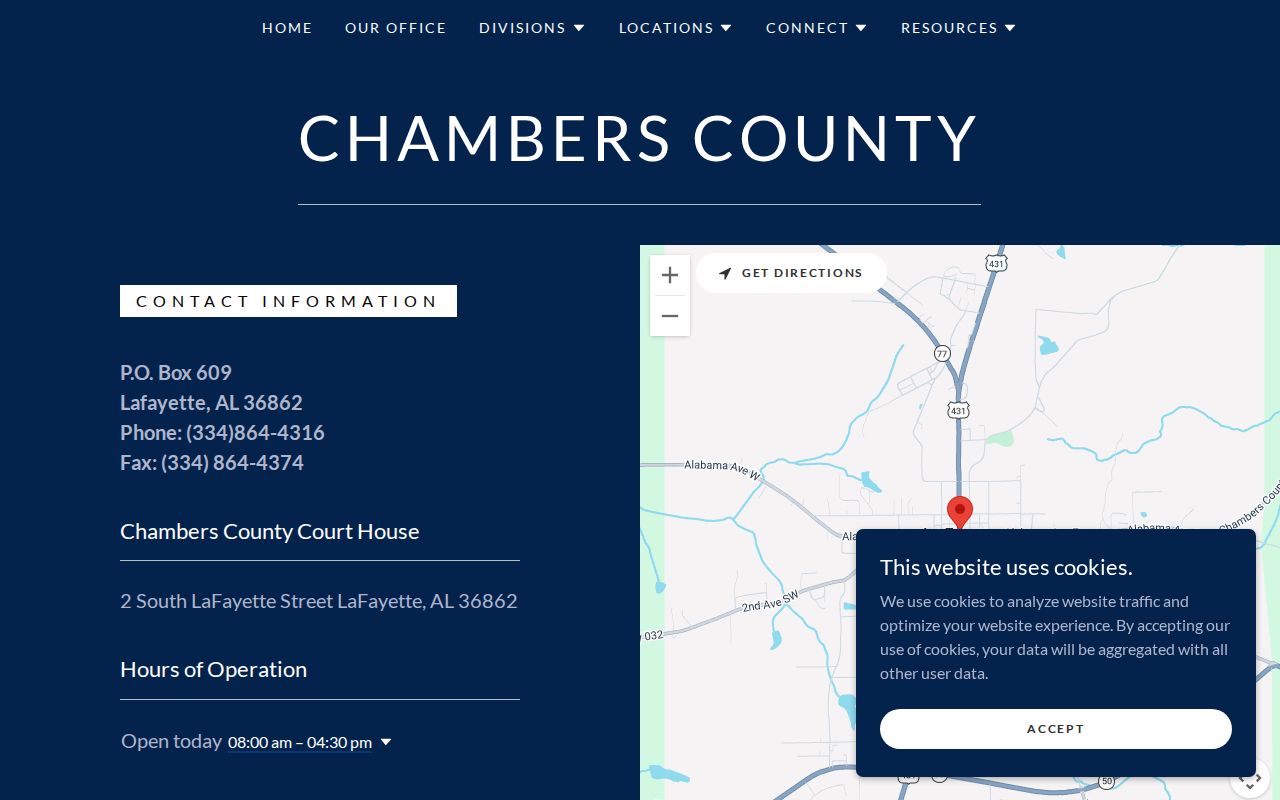
DA contact information helps identify the prosecuting authority, but case copies and docket records still come from the court record custodian.
Chambers County Criminal Case Flow
A criminal case record is best read as a timeline. Early entries may show a complaint, warrant, initial charge, or indictment. Later entries show appearances, motions, plea settings, trial settings, orders, and final sentence. One docket can hold several charges, and each charge can have a different outcome. That is why a case file must be read beyond the first charge line.
Case flow: Charges Filed › Arraignment › Pretrial and Motions › Plea or Trial › Disposition › Sentencing
| Stage | What Happens in the Record |
|---|---|
| Charges filed | The court file opens with a complaint, warrant, information, indictment, or other charging entry. |
| Arraignment | The defendant is informed of the charge and enters a plea such as guilty, not guilty, or another allowed plea. |
| Pretrial and motions | The docket may show bond matters, discovery issues, suppression motions, continuances, hearings, and judge orders. |
| Plea or trial | The record shows whether the case resolved by plea, bench action, jury trial, acquittal, dismissal, or other court action. |
| Disposition and sentence | The final entries show the outcome, sentence, probation, costs, restitution, jail or prison terms, and appeal entries when present. |
The District Attorney office biography page identifies Mike Segrest as the Fifth Judicial Circuit District Attorney.
The prosecutor's role explains why charge entries may change after filing, while the Circuit Clerk's record shows what the court accepted and ordered.
Chambers County Criminal Record Fields
Chambers trial court files can include both case-level and charge-level fields. The public user should expect enough information to identify the case, court, parties, and current status, but not every document image or confidential detail will be available to every viewer. Alacourt and Just One Look are likely electronic sources for case details and images, while certified copies and restricted-access questions still go to the Circuit Clerk.
| Field | What It Shows |
|---|---|
| Case number | The court file identifier assigned after processing. Local civil pages state parties should use case numbers when contacting the court, and the same practice helps criminal searches. |
| Court division | Whether the matter is in Circuit criminal, District criminal, traffic, or a related division. |
| Defendant and parties | The defendant name, party roles, attorneys, and sometimes the prosecuting authority or law-enforcement agency. |
| Charges | The offense or offenses filed in court, plus any amended, dismissed, reduced, or nolle prossed entries. |
| Docket history | A chronological list of filings, hearings, orders, motions, notices, service, and court actions. |
| Disposition | The final outcome for the case or each charge, such as guilty, not guilty, dismissed, no bill, or nolle prossed. |
| Sentence and financials | Jail or prison terms, probation terms, restitution, fines, costs, bond entries, and payment status when public. |
| Appeal entries | Cross-reference or appeal history if the case moves to a higher court. |
For indigent-defense context, Alabama's Office of Indigent Defense Services explains the statewide administration of appointed counsel funding.
Appointed-counsel information may appear in a criminal court file, but the practical request path is to ask the court at first appearance or arraignment.
Chambers County Charges vs Convictions
A charge is an accusation filed in court. A conviction is a final outcome after a guilty plea, verdict, or other court action that legally establishes guilt. Chambers County criminal records can show charges that never became convictions. They can also show one arrest producing several charges, with one dismissed and another resolved by plea or sentence.
| Point | Charge | Conviction |
|---|---|---|
| Meaning | An accusation filed by complaint, warrant, information, or indictment. | A final court outcome based on plea, verdict, or accepted adjudication. |
| Proof level | May begin with probable cause or prosecutorial filing. | Requires the legal standard used for conviction or a valid plea. |
| Record reading | Check later docket entries for amendment, dismissal, or no bill. | Read the sentence, costs, probation, and appeal entries with the disposition. |
| Public meaning | Does not prove guilt by itself. | Shows the court outcome unless later reversed, sealed, or expunged. |
Note: A criminal court record may list several outcomes in one file, so read each charge line separately.
Public Access to Criminal Records
Alabama public-record law supports inspection and copying of public records unless another law, rule, or court order restricts access. For court records, the Alabama Rules of Court-Record Privacy and Confidentiality also matter because court files can include confidential identifiers, juvenile information, protected addresses, sealed materials, and other restricted content. For criminal case files in Chambers County, start with the court's direct access channel when a court copy is needed.
Key authorities:
Ala. Code § 36-12-40 supports inspection and copying of public records unless an exception applies.
Ala. Code § 36-12-41 covers certified copies when a citizen has the right to inspect the record and pays the legal or reasonable fee.
Alabama court-record privacy rules define general-access and confidential court-record categories.
Sealed and Expunged Criminal Records
Restricted access is a major issue for criminal court records. Juvenile records are confidential under Alabama law. Protection from Abuse filings can include address, phone, and work-location redactions. Adoption and mental-health matters are not ordinary criminal records, but they show how Alabama courts protect sensitive files. Sealed and expunged criminal records need careful treatment because a public portal may not show a file that still exists for limited court or law-enforcement use.
| Point | Sealed | Expunged |
|---|---|---|
| Public view | Restricted from ordinary public access by law or court order. | Public access is removed or limited after a qualifying petition is granted. |
| Where filed | Handled through the court with authority over the case. | Filed in the criminal division of Circuit Court in the county where the charge was filed. |
| Examples | Juvenile records, protected PFA information, confidential identifiers, or sealed orders. | Some non-conviction misdemeanors, violations, traffic or municipal cases, and defined felony circumstances may qualify. |
| What remains | Limited access may remain for authorized court, agency, or party use. | Some court, law-enforcement, prosecutor, and statutory uses may remain after an expungement order. |
The misdemeanor and traffic expungement statute is available through Ala. Code § 15-27-1.
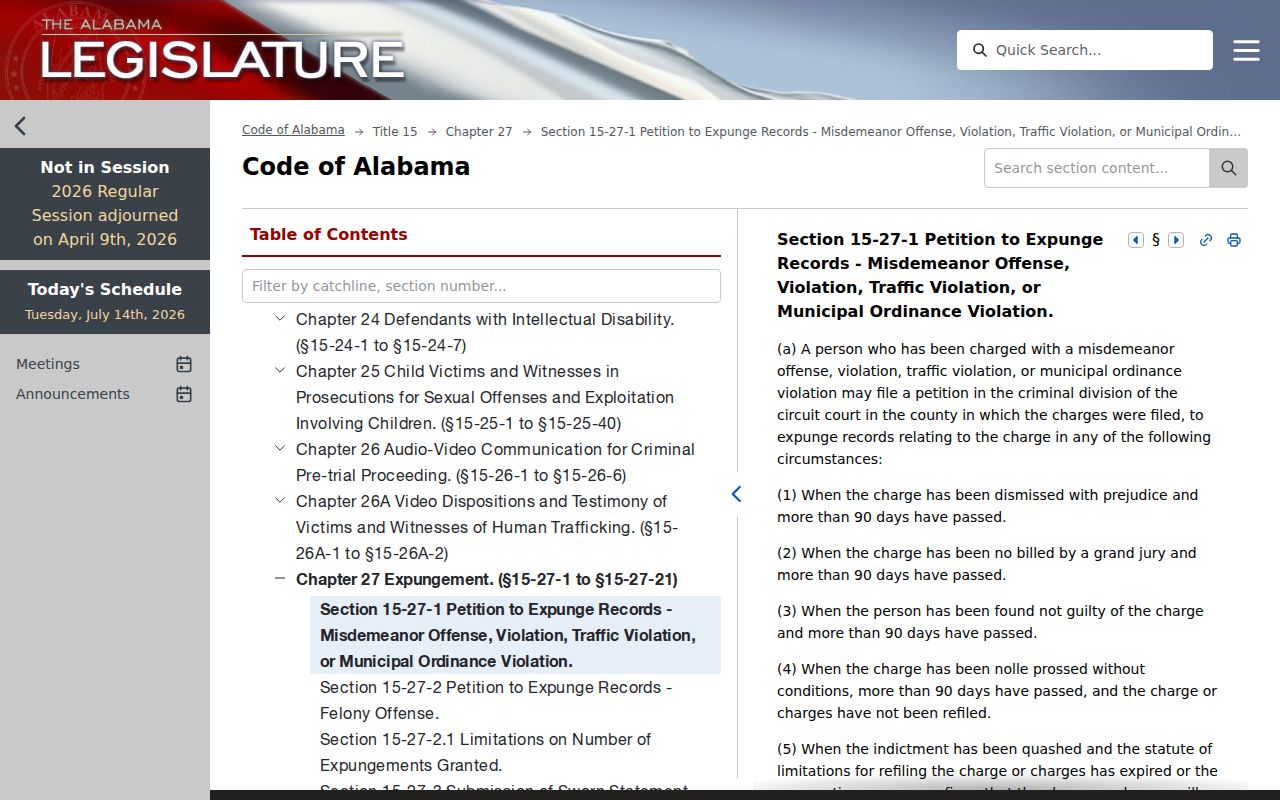
Misdemeanor and traffic expungement rules are eligibility rules, not automatic deletion of every local criminal case.
Chambers County Felony Record Limits
Felony expungement is narrower than a general court-record search. Chambers research points to Alabama felony expungement categories for nonviolent and defined no-conviction or diversion-related circumstances. The petition process uses AOC Form CR-65 and asks for case and charge details, a statutory basis, agency service, and certified supporting records such as a certified arrest record or disposition/case action summary plus an ALEA criminal record.
Felony case files can also include appointed-counsel entries, bond conditions, probation, restitution, and sentence records. A person trying to read a felony record should not stop at the charge name. The disposition and sentence sections determine whether the charge was dismissed, reduced, pleaded, tried, or sentenced.
The felony expungement statute is available through Ala. Code § 15-27-2.
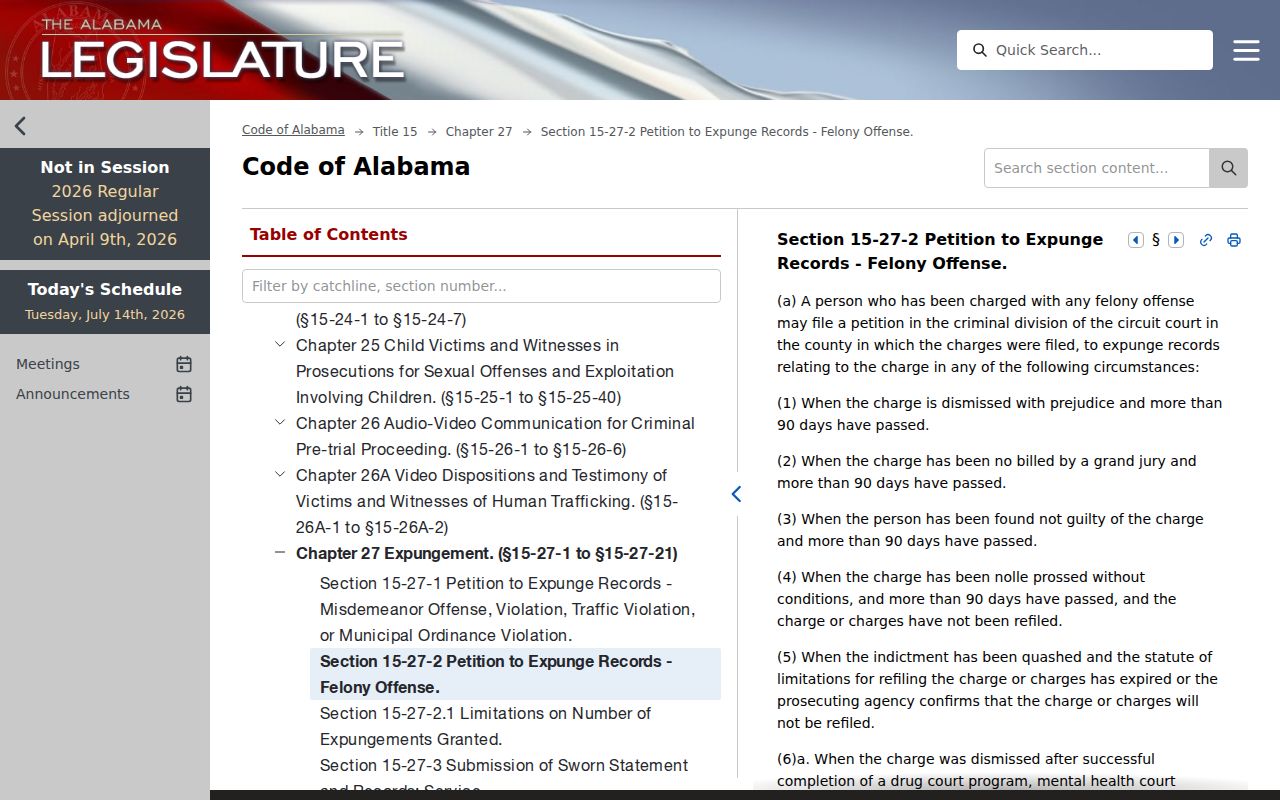
Felony expungement details belong with the case outcome because the same charge can have different public-access consequences based on its final disposition.
Restricted Chambers County Criminal Records
Some Chambers County criminal records or related records are not open in the same way as ordinary adult criminal case files. Alabama Code § 12-15-133 restricts juvenile legal, social, medical, psychological, and law-enforcement records connected to juvenile proceedings. The local Protection from Abuse process can remove protected address and contact information from court filings. Sealed orders, expunged records, confidential identifiers, and ongoing sensitive matters may also be withheld from public display.
For certified criminal records, use the Circuit Clerk rather than a broad public-record request when the court has a direct copy process. The courthouse clerk counter, the Circuit criminal division, District criminal and traffic division, and Lanett annex are the practical local channels. The clerk can help locate records and explain access channels, but Alabama court staff cannot give legal advice or interpret whether a filing should be made.